
Gurdjieff and the Gospels
Jesus said to him, “I am the way, the truth, and the life. No one comes to the Father except through Me." John 14:6 (NKJV)
The modern interpretation of the Gospels has been so thoroughly domesticated by two thousand years of institutional religion — catechism, creed, confession, and committee — that it has become almost unrecognisable.
Read without the anaesthetic of familiarity, the Gospel of John, for example, is a document about ontological transformation. The Sermon on the Mount is a manual for the restructuring of human consciousness. The Parable of the Sower is not an encouragement to evangelism. The raising of Lazarus is not primarily a demonstration of divine power.
These texts are, when read on their own terms, a transmission. Not a transmission of propositions to be believed, but of a method to be undergone. A method for transformation, through a process that is at once gruelling, grace-dependent, and cosmically consequential, something that ordinary humanity — in its current state of sleep — is not yet.
The argument I want to make in this post is this: Gurdjieff's Fourth Way and the Gospels of Jesus Christ are not merely compatible. They are, at the level of essential structure, the same teaching. The Fourth Way is the methodological interior of the Gospel. The Gospel is the metaphysical ground of the Fourth Way. Strip away Gurdjieff's labyrinthine neologism on the one side, and two millennia of doctrinal sediment on the other, and you find the same bones underneath.
Let me try to show what those bones are.
The Diagnosis of the Human Being as "Asleep"
The most radical claim both traditions make — and the one most consistently softened into irrelevance — is the diagnosis of the ordinary human condition.
Gurdjieff is unsparing. The ordinary human being, he says lives in a state of waking sleep. Not biological sleep. Functional sleep — the complete absence of genuine self-awareness, the automatic operation of personality programs installed by culture, accident, and imitation, the total identification of consciousness with the shifting surface of impressions and reactions such that there is, in functional terms, no one actually home.
The machine runs. Something that calls itself "I" runs it. But there is no real, unified, permanent "I" behind the wheel. There are dozens of small "I"s, contradicting each other, each claiming the throne for a moment before the next takes over. This is not philosophy. It is phenomenology. It describes something that any person who has tried, genuinely, to observe themselves for five consecutive minutes will recognise.
Now open Matthew 13.
The Parable of the Sower is the parable that Jesus singles out as the key to all parables: "If you don't understand this parable, how will you understand any of them?" (Mark 4:13).
What it describes is the different conditions of the human soul as soil: packed down, shallow, thorny, or deep enough to actually receive and hold the seed of the Kingdom.
The vast majority of the soil conditions in the parable are conditions of sleep: the seed lands, but the birds take it (automatic distraction); it sprouts but has no root (no real depth of being, no genuine centre capable of sustaining transformation under pressure); it grows but is choked (the "cares of this world and the deceitfulness of riches" — the machinery of identification).
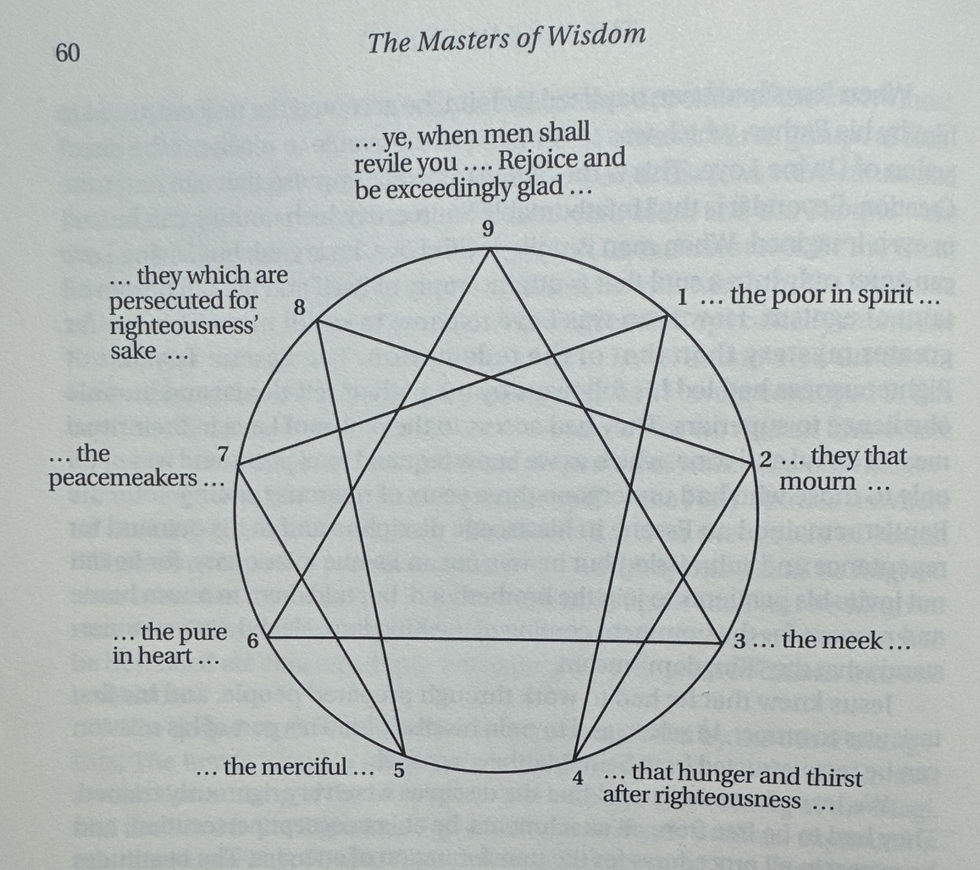
The Sermon on the Mount opens with the Beatitudes — eight apparently paradoxical blessings whose interior logic becomes immediately clear once you understand them as a description of the inner states that make genuine transformation possible, rather than a list of moral virtues to perform.
The poor in spirit are those who have seen their own inner poverty — the actual inner bankruptcy of the machine — and have not covered it with compensatory self-esteem. Those who mourn are those in whom remorse of conscience is alive enough to feel the distance between their actual being and what they are called to be. The meek are those in whom the automatic aggression of the wounded ego has been genuinely subdued — not through suppression but through something breaking in the right direction. The pure in heart are those in whom the inner fragmentation of multiple "I"s has given way to something approaching genuine inner unity.
Read through Gurdjieff's lens, the Beatitudes are a description of the stages of genuine inner work — the sequence of inner conditions that must be traversed on the way from mechanical sleep to real wakefulness. The figure below, from J.G.Bennett's "Masters of Wisdom", 1995, Bennett Books, p.60, plots the Beatitudes against Gurdjieff's Enneagram.
Both diagnoses are the same: the ordinary human condition is one of functional unconsciousness masquerading as awareness. And both traditions insist with identical emphasis that this diagnosis is the beginning, not the conclusion.
You Cannot Wake Yourself Up
This is where both systems diverge so sharply from the entire modern self-help and human potential tradition that they cannot be integrated with it without total distortion of one or both.
Gurdjieff's axiom is structural: the sleeping person cannot wake themselves up. The instrument you would use to wake yourself — your ordinary consciousness, your will, your intellect, your emotional body — is itself the thing that is asleep.
To use a sleepy will to overcome sleep is to deepen the problem, not solve it. You can, and must, make efforts. But the nature of those efforts is not the application of willpower to a manageable problem. It is the preparation of a vessel — the deliberate, sustained removal of obstacles, the conscious suffering of one's own contradictions without covering them — for something that must come from outside the ordinary human apparatus.
In Beelzebub's Tales, Gurdjieff is explicit at the cosmological level: the sole means for the saving of humanity on Earth would be to "implant again into their presences a new organ" — something that cannot be generated from within the ordinary system. Salvation is not self-generated. It requires divine intervention.
This is not a metaphor for Gurdjieff. It is a statement of ontological fact about the energetic structure of the cosmos and the human being's position within it. The energy required to form the Higher Being-Body — the immortal soul, the Kesdjan body — exceeds what the human machine can energetically generate from the food, air, and impressions of ordinary life. Something much "finer" must enter the system from above.
Now read John 3.
The nocturnal conversation with Nicodemus — one of the most concentrated passages in the entire New Testament — turns entirely on this point. Nicodemus, a Pharisee, a doctor of the Law, a man of moral seriousness and considerable religious achievement, comes to Jesus at night. He opens with a polite theological acknowledgment. Jesus cuts straight through it:
"Verily, verily, I say unto thee, Except a man be born again, he cannot see the kingdom of God." John 3:3
Nicodemus responds with the most revealing literalism in the Gospels: "How can a man be born when he is old? can he enter the second time into his mother's womb?"
The literalism is not stupidity. It is the confusion of a man trying to process an ontological claim through the categories of ordinary human possibility. And Jesus's response does not accommodate him: "That which is born of the flesh is flesh; and that which is born of the Spirit is spirit."
The second birth is not a moral improvement of the existing natural human being. It is the emergence of a categorically different quality of being within the person — a being "born of the Spirit" — that the natural human cannot produce from the material of the natural human.
Paul makes the same point with characteristic bluntness in Romans 7: "For the good that I would I do not: but the evil which I would not, that I do."
This is not the complaint of a man who hasn't tried hard enough. It is the phenomenology of the divided human being — the person in whom the higher nature (the spiritual) and the lower nature (the carnal) are at war, and in whom the higher nature cannot, by its own force alone, win. The answer Paul arrives at is not a better moral programme. It is the indwelling of the Spirit through Christ: a new energetic reality that changes the substrate on which the struggle takes place.
Gurdjieff calls this the entry of finer substances from a higher cosmic level into the human system. Paul calls it the indwelling of the Holy Spirit. The cosmological vocabulary is different. The structural necessity being described is identical: you cannot save yourself, because the mechanism that would do the saving is itself what needs to be saved.
This is not a counsel of passivity. Both traditions insist on effort — real, sustained, costly effort. But the effort is not the cause of the transformation. It is the condition of receptivity for a transformation whose cause lies outside the ordinary human apparatus altogether.
The grace is real. The effort is real. Neither cancels the other. But the order of priority is non-negotiable: grace first, effort within grace.
The Method: Intentional Suffering as the Engine of Transformation
Here is where the practical convergence between Gurdjieff and the Gospels becomes most specific — and most uncomfortable for both conventional Christians and conventional Fourth Way students.
Gurdjieff's term is Partkdolg-duty: conscious labours and intentional suffering. The key word is intentional. Not the passive suffering of ordinary life — the suffering that simply happens to you, which you endure mechanically, which leaves you more defended and more identified than before.
Intentional suffering is the deliberate turning of attention toward the aspects of one's inner life that are most difficult to face: the seeing of one's own falseness, vanity, self-deception, and automaticity without immediately reaching for the consolation of self-justification or the anaesthetic of self-contempt.
It is the suffering of staying with what is actually happening inside you, rather than fleeing into the next mechanical reaction. It is, in Gurdjieff's vocabulary, the friction between yes and no inside the human being — between the part that wants to wake up and the part that wants to remain asleep — held consciously, without the usual escape routes, long enough for something new to be generated from that friction.
The alchemical image is right: the heat of that friction is what makes possible the refinement of finer substances. Without the friction, nothing is produced. Without intentional suffering, there is no Partkdolg-duty, and without Partkdolg-duty, the Higher Being-Body is not formed.
Now read Luke 9:23.
"If any man will come after me, let him deny himself, and take up his cross daily, and follow me." Luke 9:23
The dailiness is what modern readings consistently miss. This is not a reference to the willingness to be martyred for the faith, though it includes that. It is a description of the daily inner discipline of self-denial — the daily turning away from the automatic operation of the ego's demands, the daily bearing of the friction between what the machine wants and what the higher nature calls for.
"Take up his cross daily." Not once at conversion. Daily. This is not the language of legal justification. It is the language of ongoing inner work.
The Sermon on the Mount is saturated with the same insistence. The injunction to love your enemies is not primarily a moral command to manage feelings about people who have wronged you. It is a description of the most demanding form of intentional suffering available to the embodied human being: the deliberate refusal of the automatic response (hatred, resentment, retribution) in favour of something that costs real inner substance to maintain.
Turning the other cheek is not passivity. It is the active bearing of an assault on the ego without discharging the resulting tension through the machine's preferred channel. The energy that is not discharged becomes available for something else.
Paul describes this in Romans 12:2 as the renewal of the mind through the non-conformity to the patterns of this world. The Greek term he uses for renewal is anakainosis: a genuine ontological renovation of the inner apparatus, not a cosmetic adjustment of behaviour. And its mechanism is the non-discharge of the automatic patterns — the refusal to let the machine run its usual programs, which creates the friction, and the friction creates the heat, and the heat makes the anakainosis possible.
The Beatitude "Blessed are the pure in heart: for they shall see God" (Matthew 5:8) belongs in this context. The purity of heart Gurdjieff would recognise is not moral innocence. It is the inner unity that comes from the progressive consolidation of the authentic "I" through the sustained discipline of not letting the machine's automatic "I"s run unchecked and the courage to feel the fire of remorse of conscience.
The person of pure heart is not the person who has never been tempted. It is the person in whom the inner fragmentation has been sufficiently resolved — through long, costly, grace-sustained work — that something genuinely unified is looking back at reality. And that unified something, Jesus says, shall see God. Not as a reward for good behaviour, but as the natural consequence of having developed the inner organ capable of perceiving divine reality.
Both traditions agree: the path is narrow because it requires the daily, voluntary bearing of what the machine most wants to put down.
The Narrow Way and Man Number Four
Gurdjieff's typology of human development — Man Number One, Two, Three, and Four through Seven — is one of the Fourth Way's most distinctive contributions.
The ordinary human being is Man One (dominated by instinct and movement — the body), Man Two (dominated by emotion), or Man Three (dominated by intellect). These are not gradations of virtue. They are descriptions of which centre is habitually in charge. None of them constitutes genuine inner development. They represent the inherited condition — the default operating modes of the human machine before any real work has been done on it.
Man Number Four is a critical threshold. He is the person in whom the work of inner development has actually begun — in whom a genuine magnetic centre has formed, a centre that is capable of distinguishing between influences that feed real growth and influences that feed mechanical sleep. He is the person who has, to use the Gospel language, begun to hear the teaching rather than merely receiving it as information. He is not yet free. But he has begun.
The transition from Man One to Three, to Man Four is the transition from intellectual appreciation of the teaching to actual inner engagement with it, with feeling and body included. It is the beginning of the Fourth Way in the proper sense.
Now read the Parable of the Talents (Matthew 25:14–30).
The servant who buried his talent — who received what was given and simply preserved it without putting it to use, without letting it generate anything new — is not condemned for immorality. He is condemned for non-development.
The language is stark: "to him who has, more will be given... but from him who has not, even what he has will be taken away." This is not a statement about wealth. It is a statement about a cosmic law of development: the being that does not use what has been given to generate something more does not merely stay static. Something is actually lost.
This is Gurdjieff's description of the failure to form the Higher Being-Body as a cosmic tragedy rather than a personal shortcoming. The being that passes through physical life without crystallising the immortal soul has not simply missed an opportunity. It has failed to complete the function for which it was placed in the material world. And the consequences, as both Gurdjieff and the Gospels are at pains to make clear, are not confined to the individual.
The Parable of the Ten Virgins (Matthew 25:1–13) maps the same structure. The five foolish virgins have the lamps — the external form of the teaching, the correct creedal position, the religious identity — but they lack the oil. The oil is not information. It cannot be borrowed. It is the substance that is accumulated through genuine inner work over time: the finer energetic material that Gurdjieff describes as the Hanbledzoin, the actual spiritual substance without which the lamp cannot burn when the moment of real encounter arrives.
"Afterward came also the other virgins, saying, Lord, Lord, open to us. But he answered and said, Verily I say unto you, I know you not." Matthew 25:11-12
This is not cruelty. It is a description of ontological fact. The being that has not done the inner work to develop the higher nature does not have the nature to meet what is coming. This is not about doctrinal correctness. It is about actual being. And no amount of last-minute borrowed information can substitute for the real substance that was not accumulated.
The Resurrection is Not a Conclusion
Both conventional Christianity and most introductions to the Fourth Way share a common failure: they treat their respective ultimate events — the Resurrection in Christianity, the formation of the Higher Being-Body in the Fourth Way — as the conclusion of the story. The endpoint. The reward delivered at the close of the drama.
Both traditions, read carefully, insist on something far more demanding: these are not conclusions. They are commencements.
The Resurrection in the New Testament does not send the disciples into quiet personal retirement. It commissions them: "As my Father hath sent me, even so send I you" (John 20:21). The risen Christ breathes on them — an act that echoes the divine breath of Genesis 2:7, the original animation of the human creature — and gives them the Spirit. Then sends them out. Into the world. Into service. The Resurrection is the beginning of a mission, not the end of a process.
Read Romans 8:19–22 again, slowly:
"For the earnest expectation of the creature waiteth for the manifestation of the sons of God... For we know that the whole creation groaneth and travaileth in pain together until now."
The creation is waiting. The creation is groaning. Not as a rhetorical flourish. As a statement about the actual condition of a cosmos whose proper governance has been corrupted and whose restoration depends on the emergence of human beings who have completed the transformation. The manifestation of the sons of God is not a private spiritual achievement. It is a cosmic event that the rest of creation is waiting for because it cannot properly function until that event occurs.
This is Gurdjieff's insistence that human emanations have a cosmic function — that the quality of consciousness developed or failed to develop by human beings has real consequences at levels of the cosmos well above the human. The being that completes the formation of the Higher Being-Body, does not retire into private bliss. It takes its place in the cosmic hierarchy and renders genuine service to the Megalocosmos (Universe). It becomes, in the vocabulary of the Heechtvori brotherhood, a "Son of God": a being capable of participating in the governance of creation in the way that the corrupted Ben Elohim of the Bible were supposed to but did not.
Both traditions say the same thing with identical emphasis: the destination is not just personal salvation. Personal salvation is the condition of fitness for something larger. The destination is cosmic service, cosmic co-governance, the actual participation of transformed human beings in the administration of a creation that has been waiting for them to arrive.
This is not a comfortable idea. It is far more demanding than heaven as reward and far more meaningful than enlightenment as individual liberation. It means that your transformation — or your failure to transform — is not your private business. It is a matter of cosmic consequence.
The creation is groaning. It is waiting for you to become what you were made to be.
Why the Gospels Need Gurdjieff, and Why Gurdjieff Needs the Gospels
I want to be direct about the claim I am making, because it is not a small one.
The Gospels, without the recovery of the esoteric interior that Gurdjieff preserves, have been reduced — in most of their contemporary readings — to a legal transaction (Christ pays the penalty; believer receives the pardon) appended with a set of moral instructions and a promise of post-mortem comfort. This is not false, exactly.
But it is so contracted, so stripped of its cosmological depth, so completely evacuated of its practical method, that it cannot produce what the Gospels themselves say it should produce: genuine transformation of being. It produces, instead, exactly what Gurdjieff diagnoses: sincere people doing their best to improve their behaviour while the machine of personality continues to run on sleep.
Gurdjieff's Fourth Way, without the metaphysical ground of the Gospel, risks the opposite error: a rigorous metaphysical method floating free of its source, attached to the idea of transformation without the ontological framework that explains why the transformation is possible and what it is ultimately for.
A Gurdjieff without Christ is, as my thesis argues at length, a Gurdjieff without the "Theomertmalogos" — the Word-God, the Third Force of the Sacred-Triamazikamno, the Holy Spirit, the sole source of the substance from which the immortal Higher Being-Body is formed. You cannot build the Higher Being-Body on terms other than those the Logos sets, because the Logos is the substance from which it is built.
Together, they recover something that neither has fully preserved alone.
What Gurdjieff gives back to the Gospels is its metaphysical method — the practicable, psychologically grounded method for the inner work that the Gospels describe as necessary but whose mechanics the exoteric tradition has largely lost.
What the Gospels give back to Gurdjieff is the methodological metaphysics, its source — the personal, Trinitarian, incarnate God who is not merely the impersonal Absolute of a cosmic hierarchy but the one who came, in flesh, to make the transformation possible for beings who could not accomplish it from within their own resources.
The narrow way requires both. The method without the source will exhaust itself. The source without the method will sleep.
The recovery of the esoteric core of the Gospels — the reading of the Beatitudes as a map of genuine inner development, of the cross as the daily instrument of intentional suffering, of the new birth as an ontological event rather than a doctrinal position, of salvation as the beginning of cosmic service rather than its terminus — is not a theological novelty. It is a return to what the texts have always said, for those with eyes to see.
"He that hath ears to hear, let him hear."
That is not a gentle suggestion to pay attention. It is a description of a human capacity that may or may not have been developed — the inner ear, the organ of genuine receptivity — and a quiet, urgent warning that the development of that capacity is entirely the point.


Comments